- Please enter a search term.
-
Bermuda
Canada
China
Hong Kong, SAR
India
Indonesia
Malaysia
Philippines
Singapore
United Arab Emirates
United States
Vietnam
Corporate (sunlife.com)

- Please enter a search term.
-
Life insurance
-
Bank Muamalat Indonesia
-
July 24, 2025
Sun Life Indonesia Financial Resilience Index Reveals Gen Z as the Most Vulnerable Generation Amid Inflation Pressures and a Growing Focus on Short-Term Financial Planning

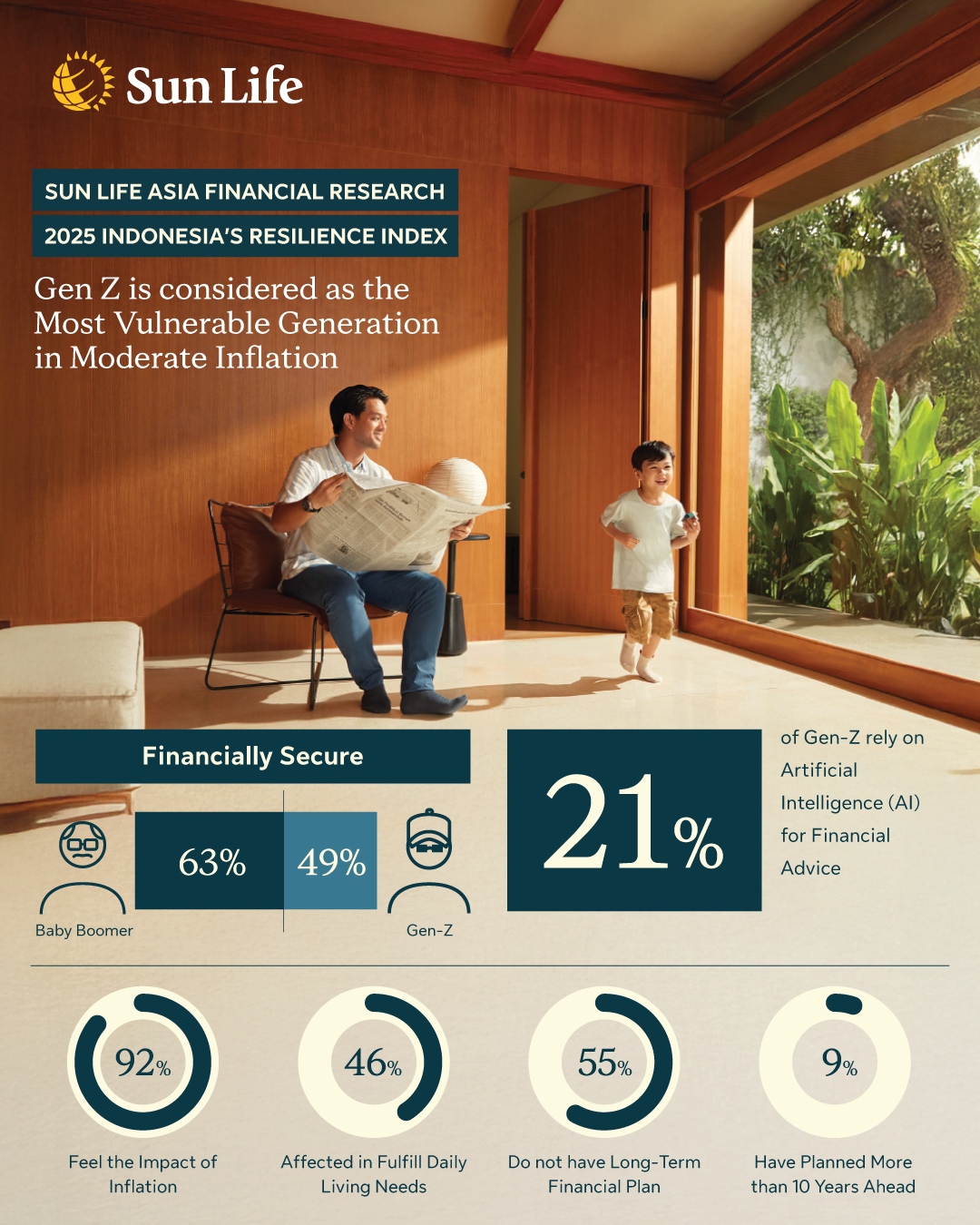
- 63% of Baby Boomer respondents feel financially secure, compared to just 49% of Gen Z
- More than a quarter of Gen Z (29%) do not seek help in making financial decisions
- 92% of respondents feel the impact of inflation, with 46% significantly affected in meeting daily living needs
- More than half of respondents (55%) do not have a long-term financial plan, and only 9% have planned more than 10 years ahead
Jakarta, 26 June 2025 – Sun Life Indonesia has released the second edition of the Sun Life Asia Financial Resilience Index: Balancing Today’s Needs and Tomorrow’s Goals, providing deeper insights into how Indonesians are managing their finances amid ongoing economic challenges.
While there has been a slight improvement in overall perceptions of financial security, the report highlights a significant gap in financial resilience across generations. Gen Z is identified as the most financially vulnerable group with the lowest long-term resilience. In comparison, 63% of Baby Boomer respondents feel financially secure, far above Gen Z’s 49%.
Gen Z Faces More Complex Financial Challenges
Gen Z shows the lowest levels of financial confidence and planning maturity across all age groups. Only 49% feel financially secure, compared to 61% of Millennials and 63% of Baby Boomers. As many as 58% of Gen Z describe themselves as conservative investors. This reflects a tendency to avoid risk and possibly a lack of understanding about the importance of balancing risk and long-term returns.
More than a quarter of Gen Z (29%) do not seek help or advice when making financial decisions. This is the highest among all age groups, despite Gen Z being the group that most needs guidance and structure in building their financial future. Interestingly, 21% of Gen Z rely on AI-based applications for financial advice, compared to 21% of Millennials, 9% of Gen X, and 11% of Baby Boomers.
Kah Jing Lee, Chief Client and Distribution Officer, Sun Life Indonesia, said:
“Gen Z has time on their side to plan their financial future, yet many are clouded by anxiety and doubt. They are growing up in an era marked by economic uncertainty and high living costs. Improving financial literacy and expanding access to reliable information can be the key to helping them build long-term financial resilience.”
Short-Term Financial Focus Dominates Amid Inflation Pressures
The inflation of recent years has made it difficult for many people to balance daily needs with long-term financial planning. As many as 92% of respondents report feeling the impact of inflation, with 46% stating it has significantly affected their ability to meet daily needs.
As a result, people’s financial focus has shifted to short-term goals. 62% of respondents say managing money for daily needs is their top priority, slightly down from 63% in 2024. Meanwhile, retirement planning, which previously ranked second, has dropped to sixth place. This shows that people are now prioritizing daily needs more than planning for retirement, which was once a major focus.
In today’s uncertain economic conditions, saving for an emergency fund has become the second most important financial priority (42%).
Long-Term Financial Preparedness Remains Low
Despite the urgent need, readiness to build long-term financial resilience remains low. More than half of respondents (55%) do not have a financial plan beyond the next 12 months, and only 9% are planning more than 10 years into the future. These figures reflect a continued lack of long-term planning that is essential for achieving sustainable financial resilience.
The Financial Resilience Gap Remains Significant
The report also highlights a sharp contrast between individuals with high financial resilience and those with low resilience.
Highly resilient individuals are better able to withstand economic challenges without sacrificing long-term financial goals. They also prioritize emergency savings (45%) and education for themselves or their children (38%).
In contrast, those with low financial resilience are more focused on paying off debt (53%) and emergency savings (45%). Only 27% of them feel able to meet short-term needs, and just 15% are confident in achieving their long-term financial goals. Alarmingly, 68% say they would not be able to sustain themselves for more than six months if they lost their job or suffered a serious health issue.
Meanwhile, highly resilient individuals show much greater confidence: 81% believe they can meet short-term needs, and 87% are confident they will achieve their long-term savings goals. As many as 51% believe they could survive more than six months in an emergency. This group is also more proactive in managing their finances: 44% consult financial advisors, 50% regularly study financial topics, and 48% actively invest.
Kah Jing Lee added:
“This report highlights the widening gap between those who are actively planning their financial future and those stuck in meeting day-to-day needs. In today’s challenging economic climate, financial literacy and long-term planning are more important than ever. That’s why Sun Life is committed to providing relevant guidance and financial solutions so that Indonesians can manage their finances with greater confidence.”